
A 2000-watt solar generator can run many refrigerators, televisions, lights, computers, small kitchen appliances, power tools, and other devices whose combined continuous demand stays below 2,000W and whose startup demand is within the system's supported limits. It cannot be judged by “2,000 watts” alone. Watts describe output power, while watt-hours describe stored energy and therefore have a major effect on runtime.
The safest way to plan is to list every load, check each label or manual, separate running watts from starting watts, and decide which devices may operate at the same time. The examples below are educational ranges and calculations, not promises for a particular appliance.
What the 2000-Watt Rating Means
A 2,000W rating normally describes the inverter's continuous AC output. In simple terms, it indicates how much electrical demand the system is designed to support at one time. If a 900W appliance, a 150W refrigerator, and 100W of lights operate together, the approximate combined running load is 1,150W. Additional devices must fit within the remaining output margin.
This number does not mean the battery stores 2,000Wh, nor does it mean every appliance labeled below 2,000W will start successfully. A solar generator is a system: the inverter determines power capability, the battery determines stored energy, and the charging equipment determines how energy can be replenished. The connected device and its behavior remain part of the equation.
Give the inverter reasonable headroom. Loads can fluctuate, labels may show nominal rather than peak behavior, and operating several appliances at the exact output limit leaves little room for a motor or compressor to start.
Running Watts Versus Starting Watts
Resistive devices such as simple hot plates often draw relatively steady power. Motor-driven appliances can be different. A refrigerator compressor, pump, furnace blower, or tool may require a brief startup surge before settling to its normal running level. The exact demand depends on the model and operating conditions.
Use the manufacturer's documentation or a suitable meter when possible. Record:
- normal running watts for each load;
- startup or surge demand for motor-driven equipment;
- how long and how often each device runs;
- whether two high-demand devices could start together;
- voltage, frequency, grounding, and waveform requirements.
Staggering loads is often the simplest solution. For example, avoid starting a power tool while a refrigerator compressor is starting and a cooking appliance is running. A load plan based on priorities can make a 2,000W system more useful than an unplanned collection of devices with the same total rating.
Common Loads and Combinations
The table shows planning categories rather than guaranteed appliance wattages. Always replace the example value with the label or measured demand of your equipment.
| Load type | What to verify | Planning concern |
|---|---|---|
| Lights, router, phone, laptop | Adapters and combined running watts | Usually modest individually, but energy use adds over time |
| Refrigerator or freezer | Running and compressor startup demand | Cycling changes both peaks and daily energy |
| Television or monitor | Label wattage and operating hours | Long viewing periods can use meaningful capacity |
| Microwave, coffee maker, hot plate | Actual input watts | High demand, even when used briefly |
| Pump, saw, drill, small compressor | Startup surge and duty cycle | Motor start may determine compatibility |
| Electric heater or large cooking device | Sustained high wattage | Can approach the inverter limit and drain capacity quickly |
A basic communications setup might combine a laptop, router, lights, and device chargers with ample output margin. A refrigerator can often be added if its documented starting behavior is compatible. A high-watt cooking device may also fit by itself, but running it together with another heating appliance could exceed the continuous rating or consume the battery rapidly.
Compatibility is not a reason to ignore energy. A 1,500W appliance may be within a 2,000W output rating yet use 750Wh in only 30 minutes. Conversely, a 100W load may operate for many hours if the battery has enough usable capacity.
How to Estimate Runtime
Use watt-hours for runtime planning:
Estimated runtime = battery capacity in Wh × planning efficiency ÷ average load in W
Consider a 1,024Wh battery. Using an illustrative 85% planning factor gives about 870Wh for a simple estimate. At a steady 200W load, that is roughly 4.35 hours. At 800W, it is about 1.1 hours. These values are examples, not guaranteed results. Inverter losses, temperature, battery condition, low-load overhead, device cycling, and load changes affect actual performance.
For cycling devices, estimate energy by time. If a refrigerator averages 70W across a full hour after cycling is considered, its eight-hour planning need would be about 560Wh before adding system losses and reserve. If you only know the compressor's running watts, do not assume it runs continuously or guess its duty cycle without evidence.
Build a small energy budget for the outage period. Multiply each device's watts by expected hours, add the watt-hours, apply a realistic loss allowance, and keep reserve capacity. Then separately confirm that simultaneous watts and startup peaks fit the inverter.
How Solar Recharging Changes the Plan
Solar panels can extend operation, but their nameplate wattage is not constant production. Real output changes with sun angle, clouds, shade, season, temperature, panel orientation, cable losses, and the power station's input limits. A 240W panel will not deliver exactly 240W throughout every daylight hour.
Estimate daily solar energy conservatively rather than treating the panel's watt rating as battery capacity. Monitor actual input and adjust loads when conditions are poor. During a multi-day outage or off-grid trip, use daylight hours for charging and schedule optional energy use after essential battery recovery. Keep panels outdoors in appropriate conditions while the power station remains protected as instructed.
A 2000W oupespowers Solar Generator Example
The Mega 1 + 240W Solar Panel Solar Generator Kit combines one Mega 1 power station with one 240W solar panel. The product table lists 1,024Wh of capacity, 2,000W of rated output, and up to 800W of solar input for the power station. The included panel is 240W, so the system's input ceiling should not be confused with the panel supplied in this kit.
This configuration can be considered for camping, RV travel, outage essentials, and basic off-grid loads whose verified requirements fit the output and energy budget. It should not be described as a guaranteed whole-home system, and a device with demand above the supported limits remains unsuitable even if battery capacity is available.
Build a Reliable Load Plan
- List essential, useful, and optional devices.
- Record running watts, startup demand, and expected operating time from reliable sources.
- Add simultaneous running loads and keep margin below 2,000W.
- Check the largest likely startup event, including other devices already running.
- Calculate total watt-hours and include conversion losses and reserve.
- Estimate solar recovery from realistic conditions, not panel nameplate power alone.
- Test the plan safely before relying on it during an outage or remote trip.
Recalculate whenever the equipment list changes. One newly added cooking appliance can affect peak watts, while a low-watt device left on all day can materially affect total energy.
Frequently Asked Questions
Is a 2000-watt solar generator the same as a 2000Wh battery?
No. A 2,000W rating describes how much output power an inverter can provide, while 2,000Wh describes stored energy. A product can have 2,000W output and a different capacity, such as 1,024Wh. Both figures are necessary: watts affect which loads can run, and watt-hours affect duration.
Can it run a refrigerator and microwave together?
Possibly, if their combined running demand plus the refrigerator's possible compressor startup stays within supported limits. Check both appliance labels and manuals. Because microwaves are high-demand loads, a safer energy-management strategy may be to pause other optional loads while the microwave operates.
Can a 2000W system run an air conditioner?
Some smaller units may fit, while others may not. Cooling equipment can have substantial compressor startup demand and sustained energy use. Verify the exact model's input and startup behavior, compare it with the power station specifications, and calculate whether the battery capacity supports the desired operating period.
How long will a 1024Wh battery run a 500W device?
The ideal division suggests about two hours, but real runtime is lower because of conversion losses, operating overhead, temperature, battery condition, and load variation. Using an illustrative 85% planning factor gives about 1.74 hours. Treat that as an estimate and validate with the actual device.
Will a 240W solar panel recharge 1024Wh in about four hours?
Not reliably. Dividing capacity by panel rating ignores changing sunlight, conversion losses, charging taper, shade, angle, weather, and any loads operating while charging. The calculation is only an ideal lower bound. Real replenishment commonly takes longer and varies from day to day.
What should never be connected without additional review?
Avoid assuming compatibility for fixed household wiring, equipment with special grounding or waveform requirements, critical medical devices, or loads whose startup demand is unknown. Follow manufacturer instructions and obtain qualified professional guidance for installation-specific electrical connections or safety-critical use.
Conclusion
A 2000-watt solar generator is best understood as a power-and-energy system, not a universal appliance list. Verify continuous and startup watts, calculate watt-hours for the intended duration, schedule high-demand loads, and treat solar production as variable. With those checks, you can decide whether a 2,000W-class kit fits your real camping, outage, or off-grid plan.
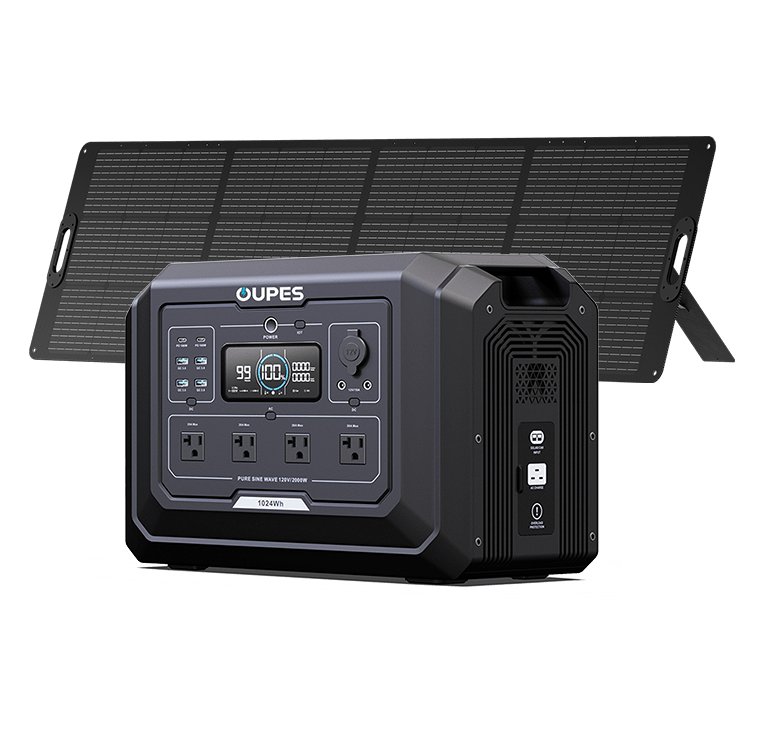
Mega 1 + 240W Solar Panel Solar Generator Kit
- Mega 1 power station plus one 240W solar panel
- 1,024Wh battery capacity for planned portable loads
- 2,000W rated output for compatible equipment
- Up to 800W solar input supported by the power station