
The right home battery backup starts with two decisions: which loads must remain available and how long they need to operate. Do not begin with the largest battery or the highest inverter rating. First build an essential-load list, measure or document its power demand, and distinguish between a portable backup arrangement and a professionally integrated whole-home system.
A practical sizing process evaluates watts, watt-hours, startup demand, charging opportunities, mobility, and expansion. The result is a backup plan matched to your household rather than a vague promise that one battery can power everything.
Define Your Backup Scope
Start with the event you are preparing for. A short utility interruption may require only communications, lights, refrigeration, and device charging. A winter outage may add a compatible furnace blower or other heating controls. A longer resilience plan may include water equipment, food preservation, remote work, and scheduled cooking. Each scope creates a different energy budget.
Classify household loads before calculating:
- Critical: health-related equipment, communications, safety lighting, and other loads that cannot reasonably be deferred.
- Essential: refrigerator, freezer, compatible heating controls, internet equipment, and selected outlets.
- Scheduled: microwave, coffee maker, tools, or pumps that can run one at a time.
- Optional: entertainment and high-energy comfort loads that can be paused when capacity is limited.
Write down the expected outage duration and a reserve. Preparing for eight hours is not the same as preparing for two days. If the plan depends on daily recharging, identify a realistic charging source and consider what happens during poor weather or a continued grid failure.
Calculate Running and Startup Watts
Watts measure power at a moment in time. Add the running watts of all devices that could operate together, using nameplates, manuals, manufacturer data, or appropriate measurements. Avoid generic estimates when compatibility matters.
Motor-driven appliances may need more power briefly when they start. Refrigerators, pumps, air conditioners, compressors, and furnace blowers can create a startup peak. The backup system must support that peak while carrying other active loads. Staggering devices can reduce the required simultaneous output, but it requires an operating plan that household members can follow.
For example, suppose the essential running loads total 1,050W. A pump may briefly add a higher startup demand. A system rated just above 1,050W would leave little room for that event or for normal fluctuation. Select output with a reasonable margin and verify surge behavior from reliable documentation. Output rating alone does not determine how long the system will run.
Convert Outage Needs Into Watt-Hours
Watt-hours measure stored or consumed energy. Estimate each load separately:
Energy in Wh = watts × operating hours
Imagine an outage plan with 120W of communications and lighting for eight hours, a refrigerator averaging 70W across cycling for eight hours, and a 600W device used for one hour. The basic energy total is 960Wh + 560Wh + 600Wh, or 2,120Wh. This is not yet the required battery size. Add conversion losses, operating overhead, uncertainty, and reserve.
If an illustrative 85% planning efficiency is used, divide 2,120Wh by 0.85, giving roughly 2,494Wh before additional reserve. A household that wants a 20% reserve would plan higher still. The correct factors depend on the equipment and conditions; the example demonstrates the method rather than a guaranteed result.
Temperature, battery condition, inverter load, device cycling, and changing household behavior affect actual runtime. Monitor real use during a test and update the energy budget. For medical or safety-critical equipment, follow the device manufacturer's backup guidance and maintain an appropriate contingency plan.
Plan Charging and Energy Management
Charging can change the amount of battery capacity needed, but it should not be treated as certain unless the source is dependable. Utility charging before a forecast storm is straightforward. Solar can extend operation during a long outage, yet production varies with panel power, sunlight, angle, shade, season, weather, temperature, and system input limits.
A power station's maximum solar-input specification is not expected continuous production. The connected panel array and real conditions determine actual energy collected. Build a conservative daily solar budget and retain enough battery reserve to pass through a poor-production period.
Energy management can reduce both system size and cost. Schedule cooking and pumping loads. Keep refrigerator doors closed. Charge phones and laptops during strong solar production when practical. Turn off idle devices, and protect a dedicated reserve for critical loads. A written load priority is easier to follow during an outage than making decisions from a falling battery percentage.
Portable Backup Versus Whole-Home Integration
A portable power station or expandable home-backup bundle can directly support compatible plug-in loads and may be moved or reconfigured within manufacturer instructions. It should not automatically be described as a whole-home, grid-interactive, or automatic standby system. Those terms can imply transfer equipment, fixed wiring, load management, permitting, and installation-specific design.
If the goal is to energize household circuits or connect backup power to fixed electrical equipment, use qualified professional evaluation. Do not backfeed an outlet or improvise a panel connection. A professional can assess transfer equipment, grounding, neutral configuration, circuit priorities, local requirements, and whether the selected equipment is appropriate.
Also consider storage location, ventilation clearances, temperature limits, cable routing, mobility, and protection from moisture. Capacity that is difficult to position safely may not fit the real household workflow.
Compare Expandable oupespowers Home Backup Options
The US product table includes three expandable Home Backup Power bundles for different output and energy requirements. The figures below are product specifications, not promises that every household load is compatible.
| Home backup bundle | Kit composition | Capacity | Rated output | Solar input |
|---|---|---|---|---|
| Mega 2 + B2 Extra Battery | Mega 2 ×1; B2 battery ×1 | 4,096Wh | 2,500W | Up to 2,100W |
| Mega 3 + B2 Extra Battery | Mega 3 ×1; B2 battery ×1 | 5,120Wh | 3,600W | Up to 2,100W |
| Guardian 6000 V2 + G5 Extra Battery | Guardian 6000 V2 ×1; G5 battery ×1 | 9,216Wh | 6,000W | Up to 3,600W |
The 4,096Wh bundle can suit a more focused essential-load plan when its 2,500W output covers verified simultaneous and startup demand. The 5,120Wh option adds both energy and a 3,600W output rating for a broader or longer plan. The 9,216Wh bundle addresses higher-output, longer-duration requirements, but a larger rating does not remove the need to calculate loads or obtain professional guidance for fixed integration.
These are bundles of a main unit and an expansion battery. They should not be represented as automatically installed whole-home systems. Solar panels are not listed in the kit composition above; the solar-input values describe the main unit's supported maximum, not included panel capacity or guaranteed generation.
Purchase and Preparation Checklist
- Define the outage duration, critical loads, optional loads, and reserve.
- Verify running watts, startup demand, voltage, and special equipment requirements.
- Calculate watt-hours from realistic operating time rather than maximum ratings alone.
- Confirm what is included in the bundle and whether charging accessories or panels are separate.
- Plan a dry, stable storage and operating location within product instructions.
- Arrange qualified evaluation for any fixed circuit, furnace, pump, or transfer connection.
- Test the approved setup, document energy use, and train household members on load priorities.
- Recheck battery charge and emergency supplies before seasonal outage risks.
Frequently Asked Questions
How many watt-hours does a home battery backup need?
There is no universal capacity. Multiply each essential load's watts by expected operating hours, total the watt-hours, then allow for conversion losses and reserve. A plan for refrigeration and communications differs greatly from one that includes pumps, heating controls, cooking, or multiple days without reliable charging.
Is a 5kWh battery enough for a house?
Around 5kWh may support a carefully managed set of essential loads, but it does not automatically support every circuit or an entire home for a fixed duration. The answer depends on load selection, startup demand, operating time, losses, weather, charging, and how aggressively optional devices are scheduled.
What is the difference between watts and watt-hours?
Watts describe instantaneous power and help determine whether equipment can operate together. Watt-hours describe energy over time and help estimate runtime. A backup system needs enough output watts for simultaneous and startup demand and enough watt-hours for the planned outage duration.
Can an expandable battery system power household circuits?
That depends on the equipment, approved accessories, electrical design, and local requirements. Do not backfeed an outlet or improvise fixed wiring. A qualified professional should evaluate transfer equipment, grounding, neutral configuration, circuit priorities, permits, and manufacturer instructions before any connection to household circuits.
How much reserve capacity should I keep?
The appropriate reserve depends on risk tolerance and critical loads. Keep margin for colder weather, longer outages, battery losses, unexpected device use, and poor solar production. For safety-critical or medical loads, follow device guidance and maintain a separate contingency rather than relying on a generic percentage alone.
Does a high solar-input rating guarantee fast recharging?
No. It states the maximum input the power station supports, not the power included panels will continuously provide. Actual charging depends on panel array size, sunlight, angle, shade, season, weather, temperature, cable losses, charging behavior, and any loads using energy at the same time.
Conclusion
Size home battery backup by working from essential loads and outage duration toward output and capacity—not the other way around. Verify running and startup watts, calculate watt-hours with losses and reserve, plan realistic charging, and distinguish portable expandable backup from professionally integrated whole-home systems. The result is a safer, clearer plan that can be tested before the next outage.
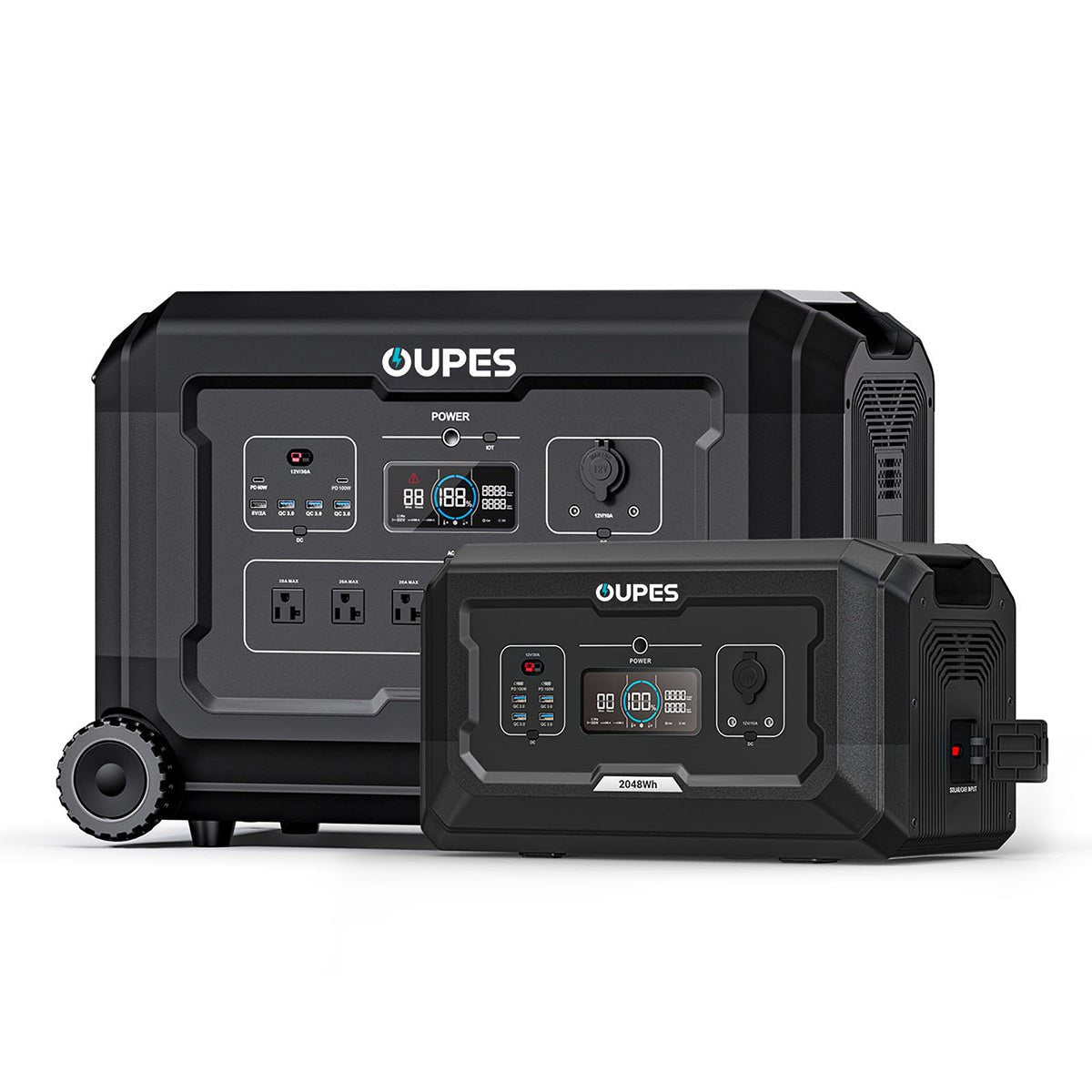
Mega 3 + B2 Extra Battery Home Backup
- Mega 3 power station plus one B2 expansion battery
- 5,120Wh combined capacity for longer backup planning
- 3,600W rated output for compatible household loads
- Up to 2,100W solar input supported by the main unit